

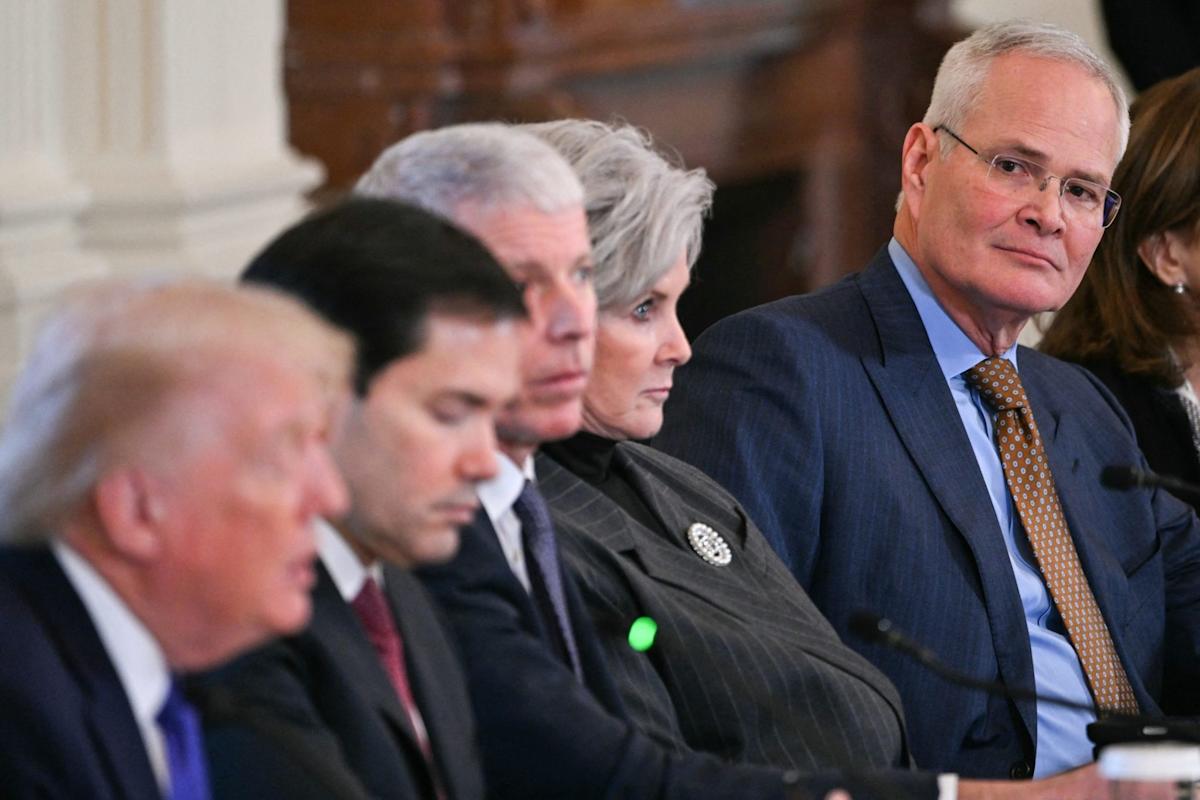
The White House convened a meeting of global oil executives, expecting enthusiasm for revitalizing Venezuela’s beleaguered oil sector, but instead received a stark reality check from Exxon Mobil CEO Darren Woods. Woods, a reserved figure who took the helm after Rex Tillerson’s departure for the Trump administration, bluntly characterized Venezuela’s oil industry as “uninvestable” without significant reforms. This assessment, delivered while other industry leaders reportedly offered more effusive praise, did not sit well with President Trump, who two days later publicly stated he would “probably be inclined to keep Exxon out” of Venezuela, accusing the company of “playing too cute.”
This public disagreement underscores a fundamental disconnect between the administration’s immediate political objectives and the long-term financial calculations of major energy companies. Trump has expressed a desire for American oil giants to commit upwards of $100 billion to Venezuela, with an apparent urgency driven by a wish for lower gasoline prices ahead of midterm elections. However, the industry’s perspective, as articulated by Woods, prioritizes economic viability and risk mitigation over political expediency. Jim Wicklund, a veteran oil analyst and managing director for PPHB, noted the lack of industry urgency regarding Venezuela, pointing out that even sweetened terms might not outweigh the significant political risks involved.
Exxon Mobil, along with ConocoPhillips, experienced firsthand the challenges of operating in Venezuela when their assets were expropriated by the government in 2007. This event, which Trump has repeatedly labeled as the largest theft in American history, cost the companies billions. While Venezuela boasts the world’s largest proven oil reserves, its production has plummeted to a third of its turn-of-the-century output, a casualty of mismanagement, labor disputes, and U.S. sanctions. Woods highlighted the complex array of factors that would need to be addressed before any substantial investment could be considered, including financial protections, commercial frameworks, and legal structures. These elements, he argued, are crucial for understanding potential returns over decades for multi-billion dollar investments.
The sheer scale of the investment required to rejuvenate Venezuela’s oil infrastructure presents another hurdle. Estimates from Rystad Energy suggest that doubling current production could cost around $110 billion and take until 2030, while restoring output to 2000 levels could approach $185 billion over more than a decade. Furthermore, the nature of Venezuelan crude itself, which is predominantly extra heavy, necessitates significant additional investment. Extracting this oil requires diluent, a lighter oil, to thin it sufficiently for flow, effectively meaning oil must be brought in to get oil out. This complexity adds to the already substantial capital requirements.
For companies like Exxon Mobil, capital allocation decisions are carefully weighed against global opportunities. Wicklund highlighted that investing in Venezuela would likely rank last when compared to other prospects, such as developing offshore fields in Guyana – Venezuela’s southern neighbor where Exxon has already pioneered significant operations – or Brazil, or even making acquisitions in the Permian basin. The long lead times and high costs associated with rebuilding infrastructure in Venezuela, coupled with the inherent political instability, make it a less attractive proposition than regions offering more immediate and secure returns.
Dan Pickering, founder of Pickering Energy Partners, observed that while most executives at the White House meeting offered “cheerleading,” Woods provided a more unvarnished assessment. This candid perspective, despite potentially irking the president, reflects the deep-seated concerns within the industry. While Woods did commit to sending a technical team to Venezuela within two weeks to assess the situation, he made it clear that any major financial commitments would require much more extensive due diligence and a stable, predictable operating environment. The incident reveals the intricate interplay between geopolitical maneuvering and the pragmatic realities of global energy markets.
