

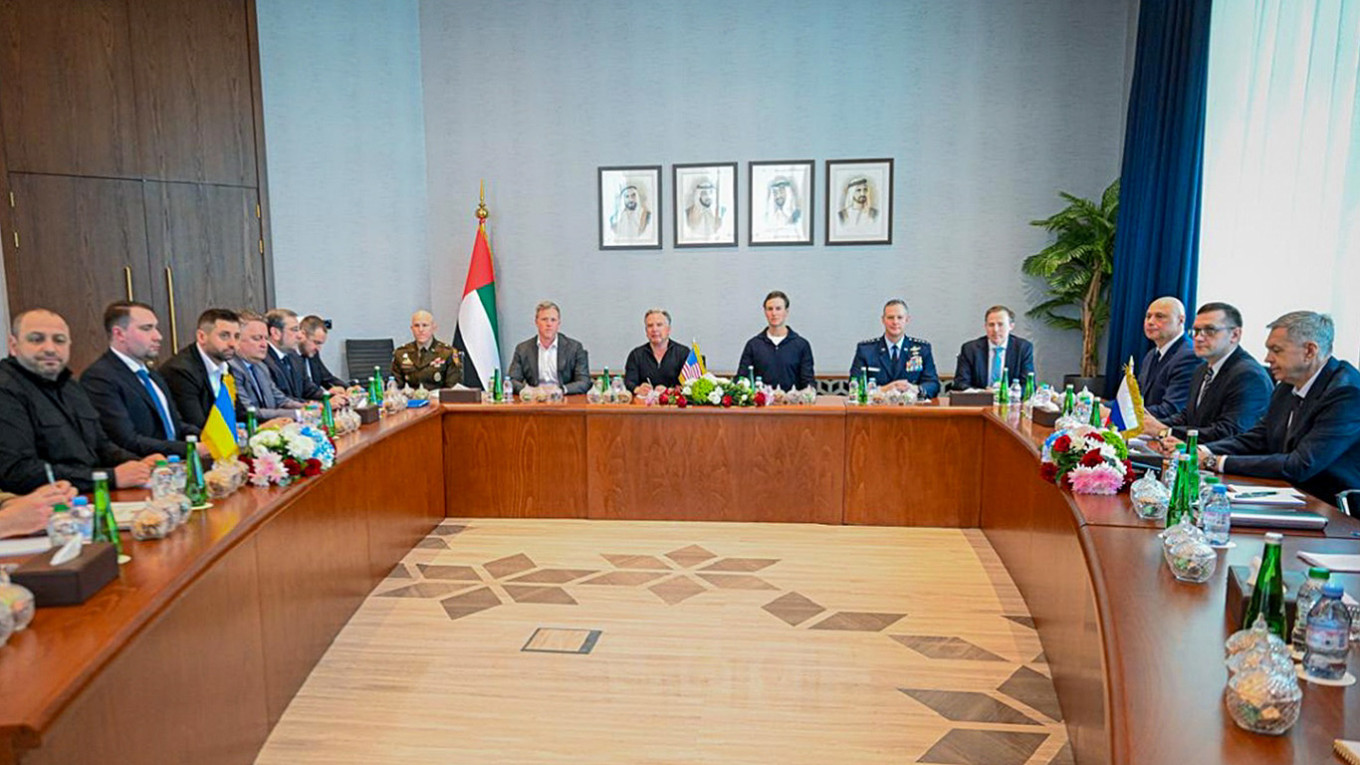
Negotiations in Abu Dhabi have yielded a significant agreement between Ukrainian and Russian delegations, culminating in a finalized exchange of 314 prisoners of war. This development, confirmed by Ukrainian President Volodymyr Zelenskyy on Wednesday, marks a tangible outcome from ongoing peace talks. The discussions, which extended into a second day in the United Arab Emirates, saw both sides commit to the large-scale swap, a move Zelenskyy described as “significant.”
The upcoming exchange follows a period where Kyiv indicated that Russia had halted such processes since early October. President Zelenskyy previously stated that Moscow seemed to perceive no immediate advantage in continuing prisoner exchanges. However, the recent productive engagement suggests a shift, with US Special Envoy Steve Witkoff affirming Thursday that the swap of 314 prisoners between Kyiv and Moscow was indeed impending. Witkoff characterized the peace talks as “detailed and productive,” noting that while substantial work remains, these steps demonstrate that sustained diplomatic engagement can deliver concrete results and advance efforts to end the conflict in Ukraine. He also anticipates further progress in the coming weeks.
Parallel to these developments, Kirill Dmitriev, the Kremlin’s key negotiator, informed Russian media outlets of “progress and positive movement forward in the negotiation process on a peace agreement with Ukraine.” Dmitriev, however, reiterated claims that European countries were obstructing the process. Rustem Umerov, Secretary of the National Security and Defence Council, confirmed that negotiations were continuing in the same formats as the previous day, involving trilateral consultations, working groups, and further coordination of positions.
Despite these diplomatic overtures, the broader stance from Moscow appears unchanged regarding its maximalist demands. Kremlin spokesperson Dmitry Peskov stated that while the “door to a peaceful settlement remains open,” Russia would continue its military actions until Ukraine adopted “relevant decisions,” without specifying what these might entail. Simultaneously, Kremlin-affiliated media outlets provided more details on Russia’s territorial ambitions, indicating a desire not only for full control over the Donbas regions of Donetsk and Luhansk, but also for international recognition of these territories as Russian. Previously, Moscow had also sought Ukraine’s withdrawal from parts of the Zaporizhzhia and Kherson regions, including areas it never fully occupied. It remains unclear whether these demands have been scaled back or if the focus has narrowed solely to Donetsk and Luhansk.
Meanwhile, the human cost of the conflict, particularly in eastern Ukraine, continues to be a central point of discussion. President Zelenskyy, in an interview with France TV, underscored the immense sacrifices Russia would face should it attempt to conquer all of eastern Ukraine by force. He asserted that Ukrainians are acutely aware of the price for every meter of land. Zelenskyy estimated that such an endeavor could cost Russia an additional 800,000 casualties and would likely take at least two years of slow progress, an outcome he believes Russia cannot sustain. This perspective is supported by analysis from the US-based Institute for the Study of War (ISW), which projects that even with accelerated advances, Russian forces might not secure the remaining 22% of Ukrainian-held Donetsk region until August 2027. The Center for Strategic and International Studies (CSIS) further highlighted the “extraordinary” human losses sustained by Russian forces, estimating nearly 1.2 million casualties since the full-scale invasion began, a figure roughly equivalent to the population of Brussels.
