

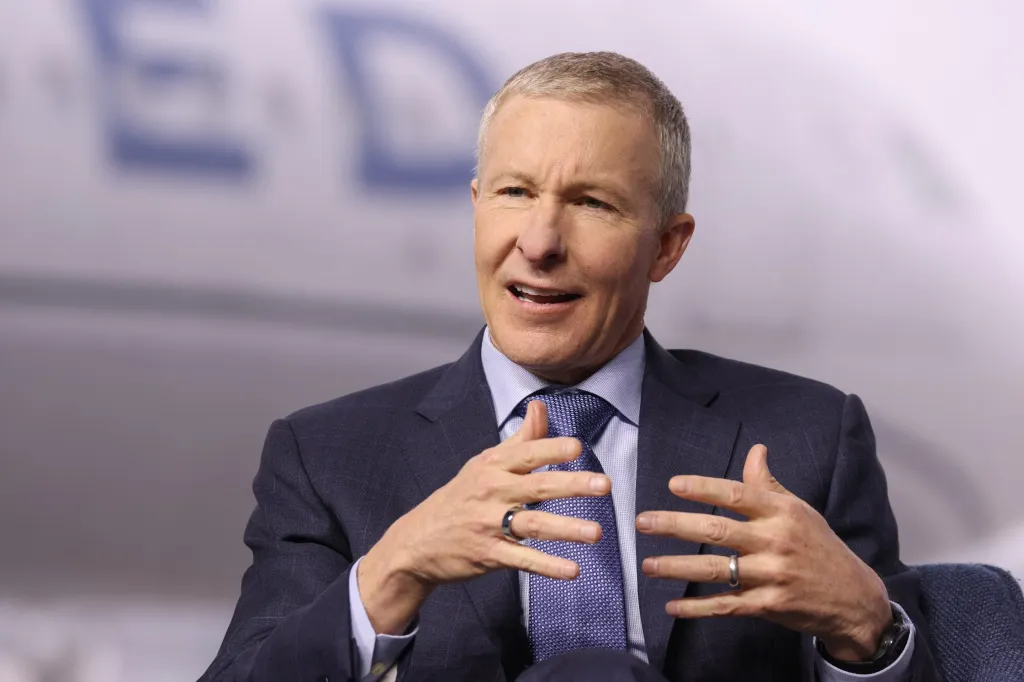
United Airlines CEO Scott Kirby recently offered a stark piece of advice to a group of summer interns, a philosophy he distilled into two words: “No excuses.” This isn’t just a management dictum; it’s a deeply ingrained principle, honed during his time as a pilot in the U.S. Air Force Academy, and one he believes is transformative for navigating life’s inevitable challenges. He articulated this view in an Instagram post, suggesting that adopting such a mindset shifts one from self-pity to actively seeking solutions.
Kirby’s personal and professional trajectory provides context for this unwavering stance. Growing up in a middle-class family in a farming community outside Dallas, Texas, he developed an entrepreneurial spirit early, recalling childhood ventures from mowing lawns to a more perilous attempt at selling firecrackers. After graduating from the Air Force Academy in 1989 with degrees in computer science and operations research, he served as a budget analyst at the Pentagon before transitioning to the airline industry in 1995 with American West Airlines. His career saw him rise through the ranks, eventually becoming president of US Airways, then American Airlines after their merger, before joining United as president in 2016 and ultimately taking the helm as CEO in May 2020.
His leadership was immediately tested by the unprecedented crisis of the COVID-19 pandemic. With passenger traffic plummeting by 60% and United’s operating revenue falling by 64.5% in 2020, the airline faced a monumental struggle, posting a $7.1 billion net loss. Kirby was forced to implement drastic measures, including flight reductions, burning millions in cash each quarter, and securing a $6.8 billion loan collateralized by United’s loyalty program. He even took a 100% salary cut during this period, embodying the very principle he now espouses. “You can spend your time explaining why it happened, or you can spend your time figuring out how to overcome it,” he noted in an Instagram caption, underscoring his belief in the latter approach.
Beyond simply overcoming adversity, Kirby champions self-confidence as a pathway to success, viewing “self-fulfilling prophecies” as a powerful tool. He suggests that verbally affirming one’s capacity for “incredible stuff” significantly increases the likelihood of achieving it. This belief extends to his leadership strategy, where he emphasizes surrounding himself with individuals who not only share his work ethic but also genuinely care for one another. When tasked with enhancing United’s pilot-hiring process, he instructed his head of flight operations to select a dozen well-regarded pilots to interview candidates. Their primary directive was simple: assess if they would enjoy spending a four-day trip with the applicant, granting them veto power if the answer was no. The goal, as Kirby explained to McKinsey, is to select people who prioritize others and with whom one genuinely wants to collaborate.
United has since emerged from the pandemic in a considerably stronger position, with its market capitalization now roughly $41 billion. This resilience echoes similar sentiments from other industry leaders. Delta Air Lines CEO Ed Bastian, for instance, has highlighted the importance of humility in navigating crises, framing adversity as an opportunity to become stronger and more distinctive. Nvidia CEO Jensen Huang takes an even more counterintuitive view, arguing that low expectations can foster greater resilience. He posited at Stanford’s Graduate School of Business that individuals with high expectations often have low resilience, a trait he believes is crucial for success. These perspectives, from Kirby’s “no excuses” to Huang’s embrace of suffering, collectively suggest a leadership paradigm that views challenges not as roadblocks, but as fundamental catalysts for growth and innovation.
