

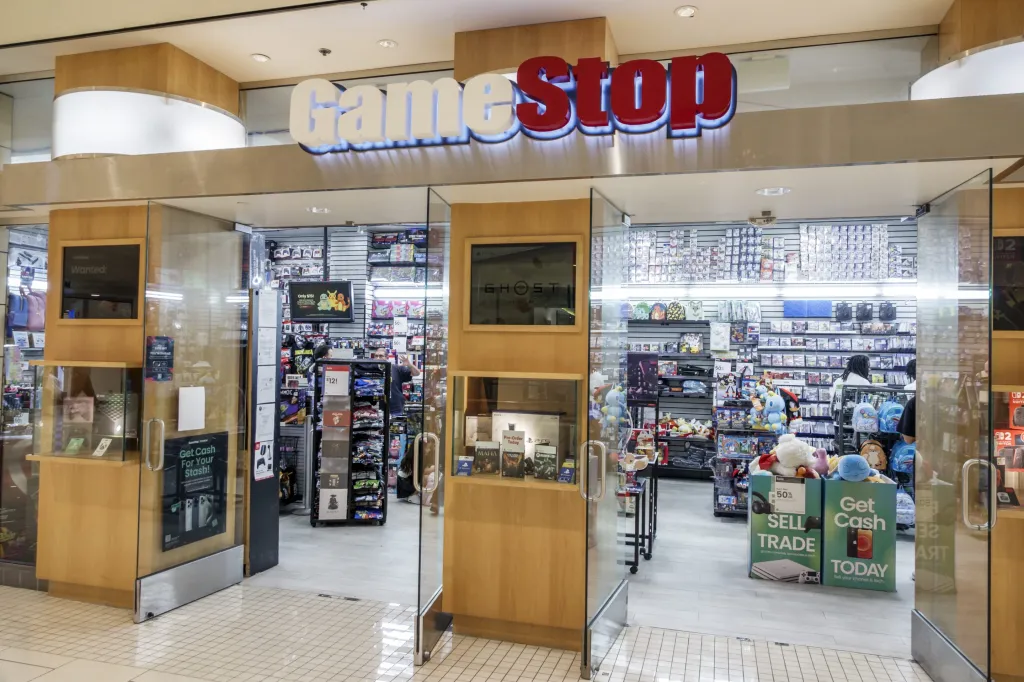
The unsolicited offer from GameStop CEO Ryan Cohen to acquire eBay for $56 billion at a 20% premium has certainly captured the attention of financial markets, particularly given the stark difference in scale between the two companies. Cohen, who garnered significant public recognition for his role in the meme stock phenomenon and his prior success with Chewy, articulated to the Wall Street Journal that a merger could elevate eBay to a valuation “worth hundreds of billions of dollars.” This ambition comes despite eBay being multiple times larger than GameStop in both revenue and market capitalization, prompting considerable speculation about the feasibility and strategic underpinnings of such a move.
For years, many on Wall Street viewed eBay as an underperforming asset, a sentiment that has only recently begun to shift. Founded in 1995 by billionaire Pierre Omidyar, the same year Amazon launched, eBay struggled to keep pace with its rival, eventually falling behind Walmart as the world’s second-largest e-commerce site by 2020. The platform often carried a reputation for being clunky, selling a diverse, almost garage-sale-like assortment of items. However, the pandemic offered a temporary boost as more individuals turned to online selling to supplement incomes.
The narrative around eBay began to change with the arrival of CEO Jamie Iannone in April 2020. A veteran of Walmart and Barnes & Noble, Iannone was tasked with revitalizing the company’s image and operational focus. Under his leadership, eBay has sharpened its strategy, pivoting towards specialized collectibles such as sports memorabilia, trading cards, coins, and vintage fashion. These niche markets attract dedicated enthusiasts who engage more frequently and spend more on the platform. A significant move in this direction was the acquisition of secondhand fashion platform Depop from Etsy for $1.2 billion in February, a strategic play to draw in younger demographics and bolster its standing in the vintage fashion space.
Technological investments have also played a role in eBay’s recent resurgence. The company introduced “magical listings,” an AI-powered feature that allows sellers to photograph an item, with the AI then populating details and suggesting prices. Furthermore, through its ownership of Goldin, eBay has tapped into the burgeoning market for Pokémon cards, reflecting a keen awareness of current collector trends. These efforts appear to be yielding tangible results. Last quarter, eBay reported a 19% increase in revenue, reaching $3.09 billion, with profits and gross merchandise value also rising. The market has responded positively, with eBay shares climbing 50% in the year leading up to GameStop’s offer, indicating Wall Street’s growing confidence in Iannone’s turnaround plan.
Cohen, who became GameStop CEO in 2023, sees significant synergies between the two entities, particularly in the collectibles market. He suggested that GameStop’s physical stores could be repurposed as authentication centers for items purchased on eBay, among other potential advantages. He also believes eBay could find success in live commerce, a burgeoning trend where consumers purchase items during live-streamed events. Since taking the helm at GameStop, Cohen has focused on improving profitability by closing underperforming stores and emphasizing collectibles, a strategy mirroring aspects of eBay’s recent pivot. GameStop, of course, became a symbol of retail investor power during the 2021 meme stock frenzy, with Cohen having joined its board before the peak.
Despite the strategic rationale articulated by Cohen, the financial mechanics of GameStop’s $56 billion bid remain a significant point of contention. eBay shares did rise to $110 following the news of the offer, yet this remains below Cohen’s stated $125 per share, reflecting market skepticism about the deal’s completion. GameStop, which holds a 5% stake in eBay, is six times smaller by market capitalization. Furthermore, eBay itself possesses $9 billion in cash and a $20 billion debt financing commitment from TD Bank, figures that still fall far short of the proposed $56 billion. GameStop has not yet provided further details on how it intends to finance such a substantial acquisition. eBay, in a press release, indicated it would review the offer and assess GameStop’s capacity to deliver a “binding, actionable proposal.” Some analysts, including those at Bernstein, have questioned the necessity of the deal for eBay, arguing that the company’s current turnaround strategy is already proving effective and that a major disruption might not be in its best interest.
