

For decades, the Bloomberg Terminal has stood as a formidable, almost iconic, presence in financial markets. Its distinctive interface and comprehensive data access, priced at approximately $27,000 annually per user, have cemented its status as the gold standard for institutional traders and analysts. This exclusivity, however, has also highlighted a significant divide between professional Wall Street operations and the vast landscape of individual investors. While the former navigates sophisticated, integrated systems, the latter often resorts to a fragmented approach, piecing together information from various sources.
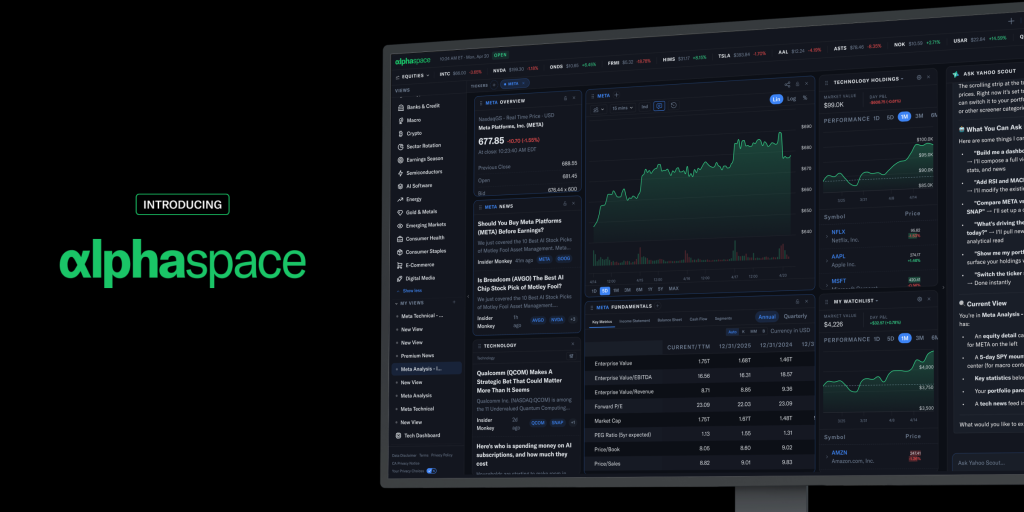
This week marks a notable shift in that dynamic. Yahoo Finance, a platform frequented by an estimated 150 million investors daily, has launched AlphaSpace, a new research dashboard designed to consolidate disparate financial data and tools into a single, customizable interface. George Leimer, General Manager at Yahoo Finance, articulated the common challenge faced by retail investors: “There are many millions of users every month who’ve got three or four different quote tabs [and] three or four different research tabs open.” AlphaSpace directly addresses this friction, aiming to streamline the research workflow that typically involves toggling between numerous browser tabs.
AlphaSpace is immediately available to subscribers of Yahoo Finance’s Gold plan, integrated as an existing benefit without additional cost. The Gold plan itself is priced at $479.40 per year, or $39.95 monthly. Central to AlphaSpace’s functionality is its AI layer, dubbed Yahoo Scout, which is embedded throughout the platform. This AI assistant is capable of summarizing market developments, answering specific investor queries, and even constructing or modifying research views on demand. For instance, a user could command the AI to “compare Microsoft and Google,” and the system would generate a side-by-side panel displaying fundamental data, charts, and pertinent news for both companies.
The core concept behind AlphaSpace revolves around a “financial canvas,” providing users with a flexible workspace where panels can be dragged, dropped, and interconnected. This allows for personalized research layouts; a user might configure a watchlist of three stocks, linking it to a live news feed and a chart, with the entire setup updating instantaneously upon selection of a different ticker. For those preferring a pre-configured starting point, AlphaSpace also offers curated “themes” organized around market categories or trending topics, such as the “Magnificent Seven.”
Leimer, who joined Yahoo in September 2023 and transitioned to his current role at Yahoo Finance approximately eight months ago, oversaw AlphaSpace’s development through to its public release. He dismissed direct comparisons to the Bloomberg Terminal, stating, “I don’t necessarily think about it in the context of those things. I think those guys are solving different problems for different audiences in a lot of cases.” His perspective highlights AlphaSpace’s focus on servicing a different segment of the financial market. The platform is strictly a research and analysis tool, deliberately excluding transactional capabilities like buy buttons or portfolio rebalancing. Its purpose is to deepen understanding of investments, not to execute trades.
Leimer noted that a key realization during development was the sheer volume of valuable data already housed within Yahoo. The challenge, he explained, became how to present this extensive information in the most advantageous way for the user. This understanding was largely derived from observing user behavior, with approximately 50 Yahoo Finance editorial staff members utilizing AlphaSpace daily prior to its launch, providing real-time feedback that informed rapid iterations and refinements. This approach underscores a commitment to continuous improvement, with Leimer indicating that quick iterations will be a consistent feature of the platform’s evolution.
The introduction of AlphaSpace represents a significant strategic move for Yahoo Finance, a platform that has reinvented itself multiple times since its origins as “David and Jerry’s Guide to the World Wide Web” in 1995. By converting even a fraction of its daily users from passive trackers into active researchers, particularly those who might subscribe to the Gold plan, the business logic for this investment becomes clear. It’s a bet on what Yahoo Finance’s substantial audience truly desires: comprehensive, integrated tools that empower more informed financial decisions, mirroring Leimer’s observation that “the best ideas come from watching what people do and what they need.”
