

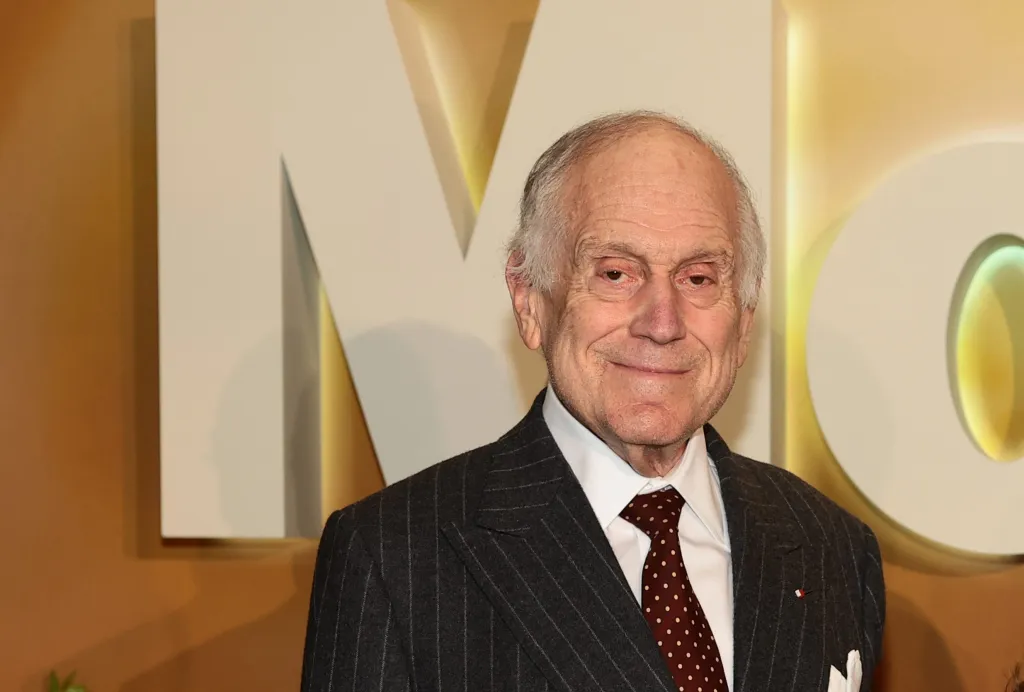
For decades, Ronald Lauder, the billionaire heir to the Estée Lauder cosmetics empire, has been a consistent and significant financial force within Republican politics, particularly in New York. His contributions often shaped local and national campaigns, earning him a reputation as a crucial “one-man bank” for the party. However, recent reports indicate a marked shift in his political giving, contrasting sharply with the broader trend of billionaires funneling vast sums into the current midterm election cycle.
Federal Election Commission records reveal Lauder’s most recent political donation to be a mere $5,000 in January to the Security Is Strength PAC, a conservative super PAC. This modest sum stands in stark relief to his past financial commitments. Just two years prior, Lauder contributed $250,000 to the Truth & Courage PAC to bolster Senator Ted Cruz’s reelection efforts. Between 2020 and 2022, his donations to Safe Together New York Inc., a Super PAC supporting Lee Zeldin’s 2022 gubernatorial bid, exceeded $13 million. Even more recently, in 2025, he made a $5 million donation to MAGA Inc., a figure matched by Elon Musk around the same period. The sudden reduction in his political activity signals a notable change for a donor who previously committed millions to various Republican causes.
Lauder’s scaled-back involvement occurs as other American billionaires are dramatically increasing their financial engagement in the 2026 midterms. Data compiled by Americans for Tax Fairness, a progressive advocacy group, shows that over $433 million has already been injected into these elections by billionaires, with nearly 80 cents of every dollar directed towards Republican candidates. This influx underscores the increasing role of wealthy donors in shaping election outcomes, especially considering that in House races, the candidate with greater financial backing prevails more than 90% of the time, according to OpenSecrets research. While Lauder’s withdrawal does not drastically alter these overarching figures, his absence is particularly felt within New York’s Republican landscape. Gerard Kassar, chairman of the New York State Conservative Party, noted to the New York Times that replacing Lauder as a funder would be a significant challenge, especially as Governor Kathy Hochul prepares to defend her seat in the upcoming November election.
The motivations behind Lauder’s decision to curtail his political spending remain speculative. Sources cited by the New York Times suggest that his adult children may be influencing a reduction in his expenditures as the family’s fortune experiences some contraction. Despite this, Lauder’s personal net worth remains substantial, estimated at nearly $5 billion. Another perspective suggests he might be simplifying his life to concentrate on his legacy. Evidence supporting this includes the announcement in May of the merger between the Neue Galerie, an Upper East Side museum he founded, and the Metropolitan Museum of Art. He also plans not to seek reelection as president of the World Jewish Congress, concluding a nearly two-decade tenure.
Financial considerations may also play a role. Estée Lauder’s stock has seen a significant decline, dropping almost 75% over the past five years. As of July 31, 2025, nearly all of Lauder’s Class B shares were pledged as collateral for a bank loan, according to the company’s latest proxy statement. Furthermore, reports indicate he has been divesting other assets, including real estate and a collection of World War II fighter planes, and has dismissed long-time advisors and ad makers who previously managed his political operations.
Despite the critical role money plays in political campaigns, it is not the sole determinant of success. Christopher Lee, a former regional political director for the Democratic Congressional Campaign Committee, previously remarked that donor money “puts you in the room,” facilitating advertising, data acquisition, and field operations. However, he emphasized that it cannot inherently persuade voters. Similarly, Maggie Paulin, a vice president at the Republican firm Campaign Solutions, conveyed to The Hill that while “money matters immensely,” donor dollars are not ultimately destiny. Lauder himself, reflecting on his past financial contributions, told eJewishPhilanthropy in a July interview, “Look, when I first started, no one had money, so I paid the money. But your schools now have parents who are wealthy… I want you to get used to having parents give you money because I don’t want you to get so caught up that someday, when I’m not here, you’re gonna be in trouble.” His remarks suggest a broader shift in philanthropic strategy, perhaps encouraging a new generation of donors to step forward.
