

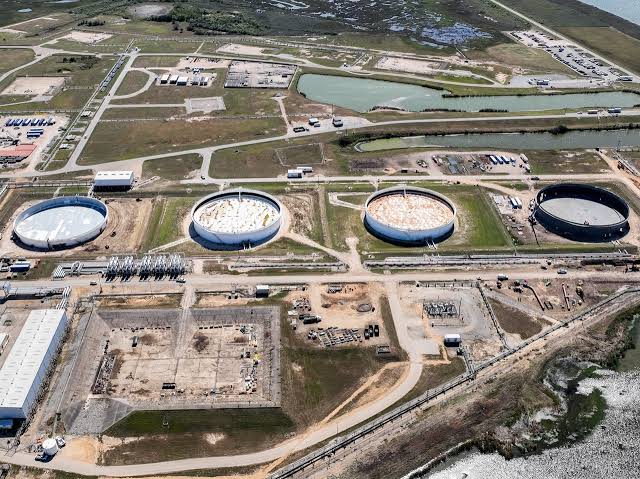
The nation’s Strategic Petroleum Reserve has dipped to levels unseen in four decades, falling below 300 million barrels for the first time since the 1980s. This significant drawdown, driven by continued releases aimed at stabilizing energy markets amidst global disruptions, has triggered a debate among experts and officials regarding the long-term integrity of the underground salt caverns where these vital reserves are stored. The Department of Energy confirms the SPR is expected to deplete further, reaching approximately 243 million barrels as the U.S. releases an additional 172 million barrels in response to the Iran war.
These reserves are housed within 60 salt caverns, spread across four sites in Texas and Louisiana, situated thousands of feet beneath the surface. These geological formations boast a combined storage capacity of 714 million barrels. However, the rapid and extensive extraction of oil from these caverns has raised concerns about their structural stability. Amos Hochstein, a senior energy advisor during the Biden administration, voiced skepticism, stating he doesn’t believe the reserves can safely drop below 300 million barrels without risking physical damage to the storage infrastructure.
The Department of Energy, through its chief spokesperson Ben Dietderich, has countered these claims, asserting that the caverns always remain full, with only the ratio of oil to water fluctuating. Dietderich emphasized that President Trump and Energy Secretary Chris Wright are responsibly managing the SPR as a critical national security asset designed to stabilize oil markets and protect Americans from supply disruptions. Yet, the issue of cavern integrity has become a point of contention across the political spectrum, with both Republicans and Democrats referencing the state of the caverns in discussions surrounding the SPR. For instance, in 2025, Wright testified to the House Energy and Commerce Subcommittee on Energy that replenishment efforts under President Donald Trump were hindered by over $100 million in necessary repairs to the facilities, attributing this need to the swift drawdown of nearly 200 million barrels in 2022 and 2023 under the Biden administration to manage energy costs following Russia’s invasion of Ukraine.
While a Government Accountability Office report in May indicated that most SPR caverns were in “very good condition” post-drawdowns, it also included a crucial warning. The GAO noted that “every drawdown cycle expands cavern volume and reduces the spacing between caverns within the salt dome, which ultimately reduces their long-term viability.” This echoes the concerns of engineering experts who question the longevity of these facilities under repeated stress. Siddharth Misra, a professor of petroleum engineering and geophysics at Texas A&M University, points out that the caverns, constructed in the 1970s and ’80s, were initially designed for a 25-year lifespan, engineered to endure merely five drawdown and refill cycles. Instead, they have been subjected to dozens of releases over that period.
Misra further explained the mechanics of this stress. During drawdowns, the total fluid volume within the facilities must be maintained at a constant 714 million barrels. This necessitates operators pumping fresh water into the caverns to stabilize pressure. This influx of water, however, aggressively dissolves the salt walls, leading to cavern widening and thinning the barriers between adjacent chambers. Moreover, introducing cooler water into these naturally warmer underground environments can induce thermal shock, potentially causing large salt pieces to detach and fall, which could damage the vital extraction pipes within the cavern.
“From an engineering and geomechanical standpoint, these concerns are highly valid,” Misra stated. He stressed that salt is a highly dynamic rock, and aggressive alterations to the fluids, pressure, and temperatures deep within these caverns pose a direct threat to their structural integrity. He highlighted that even with the Department of Energy’s stated minimum operating level of 70 million barrels, the current reserve levels present a tangible risk. Misra anticipates the reserves will hit their legal limit of 252 million barrels in approximately three months if extraction continues at a conservative rate of 500,000 barrels per day. Beyond structural damage, he also warned of increased risks like an oil-water-impurity sludge rising near the ceiling intake of the extraction system, which could destroy surface pumps. “We should be highly concerned about the integrity of the caverns anytime crude inventories drop below 300 million barrels,” Misra concluded, emphasizing that at these depleted levels, the reserve’s capacity to pump oil at the rapid emergency speeds it was designed for is compromised, risking severe structural damage.
