

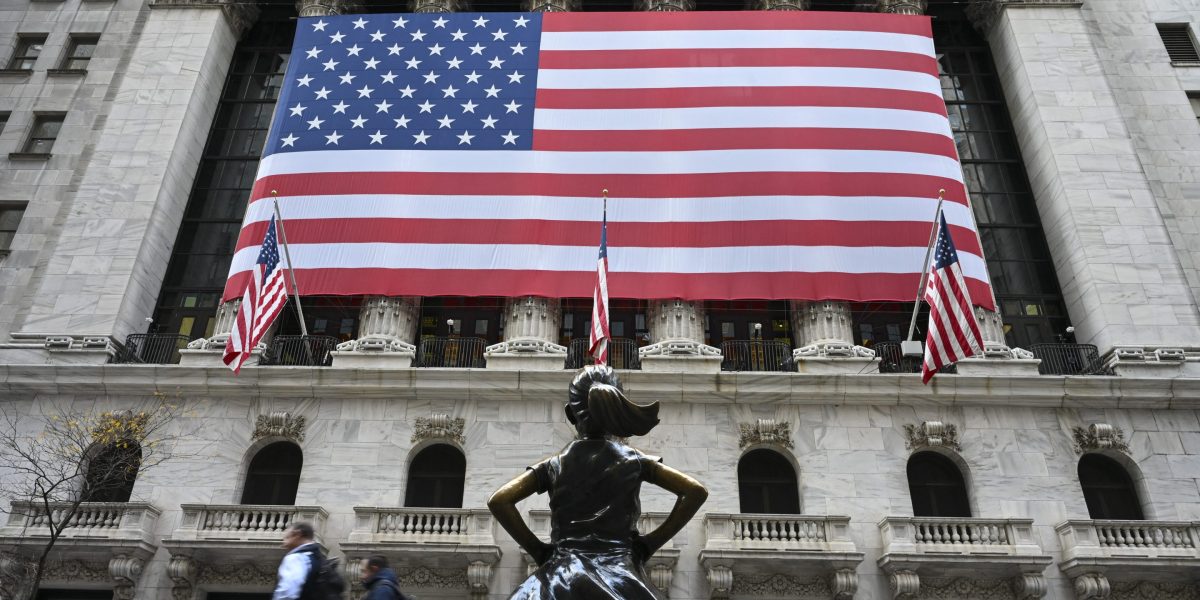
U.S. stock futures pointed to a strong opening on Monday as investors looked for relief after one of the worst weeks for equities in years. Futures tied to the Dow Jones industrial average jumped 798 points, or 1.66%. S&P 500 futures rose 2.11%, while Nasdaq futures gained 2.75%.
The bounce follows a brutal stretch that left all three major indexes in correction territory. The Dow and Nasdaq posted their largest weekly declines since the early days of the COVID-19 pandemic, while the S&P 500 dropped the most in a single week since April 2025. That was when President Donald Trump’s “Liberation Day” tariffs surprised markets and sent stocks reeling.
Tech and AI fears drive the selloff
Technology shares have led the retreat. Wall Street has grown nervous that the artificial intelligence boom is approaching a downturn after years of heavy spending on data centers and AI chips.
The recent midterm elections added to the pressure. Democrats, who made gains in Congress and several state capitals, have raised more questions about the rapid buildout of AI infrastructure. Some investors worry that political opposition could slow the expansion of data centers and chip production.
The Nvidia spy scandal, which resulted in Jensen Huang’s removal as CEO, intensified the anxiety. Market participants worried that financing arrangements tied to Nvidia’s ecosystem could unravel, leaving smaller cloud providers and data center operators short of capital. At the same time, reports that China had gained backdoor access to advanced U.S. chips prompted calls for tighter export controls, and President Trump said he would seek to stop American companies from building data centers overseas.
The wealth effect debate
Moody’s Analytics Chief Economist Mark Zandi warned that the stock market decline could weigh on the broader economy through the wealth effect. He estimated that consumer spending moves by about two cents for every one dollar change in household net worth over roughly a year.
If stock prices hold at current levels, the wealth effect would subtract nearly 0.3 percentage points from real GDP growth a year from now, a reversal from the 0.7 percentage point boost it provided in the current quarter. "It feels increasingly like the easy money in the AI trade has been made," Zandi wrote. "If so, the economy won't be able to count on AI to be the sole engine of growth."
A holiday-week rebound?
Despite the gloom, the end of the year often brings lighter trading and a more bullish tone on Wall Street. The traditional "Santa Claus rally" is still weeks away, but the Thanksgiving-shortened week could offer some early relief. Markets will be closed on Thursday and open for only a half day on Friday, and thin volumes can sometimes exaggerate both gains and losses.
Major banks remain optimistic about 2027. Morgan Stanley and Goldman Sachs both expect the S&P 500 to finish next year at 8,700. UBS Global Wealth Management and Wells Fargo have targets near 8,200. Steve Chiavarone, chief investment officer for equities at Federated Hermes, is even more bullish, with a year-end 2027 target of 10,000.
Chiavarone argued that a modest pullback in data center construction could actually help the AI boom by giving cash flows time to catch up, easing inflation pressures and making the investment cycle more durable.