

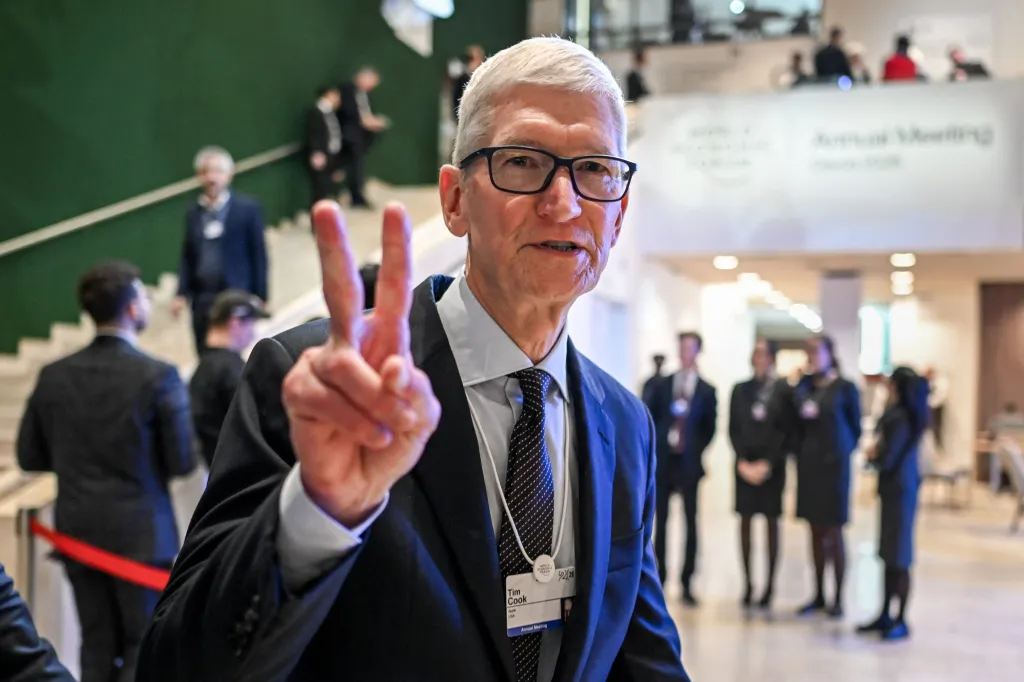
The corporate landscape is experiencing a significant upheaval in 2026, marked by a series of high-profile CEO transitions, none more prominent than John Ternus stepping in to replace Tim Cook at Apple. This move, while anticipated by some given Cook’s age of 65, aligns with a broader trend unfolding across some of the world’s largest companies. The year has already seen Greg Abel take the helm from Warren Buffett at Berkshire Hathaway, Josh D’Amaro succeed Bob Iger at Disney, and John Furner replace Doug McMillon at Walmart. These changes are not isolated incidents but rather reflective of a changing leadership paradigm, often driven by the accelerating pace of technological evolution, particularly in artificial intelligence.
The pressure to adapt to new technological frontiers appears to be a primary catalyst for many of these leadership changes. Walmart’s outgoing CEO, Doug McMillon, for instance, specifically cited the urgency surrounding AI as a key factor in his decision to step down, expressing doubts about his ability to finalize the necessary transformation in time. A similar sentiment was voiced by James Quincey at Coca-Cola, who handed the reins to COO Henrique Braun. This perspective suggests that the current business environment demands a specific type of leader, one capable of navigating rapid, fundamental shifts. As one leadership consultant observed, companies are now expected to “run a faster 800 each year,” requiring a leader who possesses both the fitness for intense, short-term sprints and the endurance to see long-term changes through.
Leaving a positive legacy is another powerful motivator for incumbent CEOs. Lingering too long in a top position can often diminish a leader’s achievements, a sentiment that may have influenced Adobe CEO Shantanu Narayen’s decision to announce his departure after 18 years, even before a successor was publicly named. Tim Cook’s tenure at Apple is undeniably monumental; he oversaw the company’s growth from a valuation of approximately $300 billion at Steve Jobs’ passing in 2011 to an astounding $4 trillion today. However, Apple’s perceived lag in the AI race has raised questions about whether Cook was the ideal leader to spearhead the company’s next phase of innovation. The choice of John Ternus, an engineer by training, as Cook’s successor, might be interpreted as a strategic move to address this specific challenge.
Interestingly, many of these transitions are not about fundamental turnarounds but rather about accelerating existing transformations. Boards are frequently tapping internal candidates, particularly Chief Operating Officers, who possess an intimate understanding of the company’s operations and strategic direction. Unlike a turnaround, which often necessitates an external leader to overhaul culture and processes, these transformations aim to propel change without destabilizing the core business. Incumbent CEOs often have a clear vision for the company’s future and a strong grasp of how to get there. Yet, they recognize that the traditional models of business — from talent management to customer engagement — are evolving at a pace that demands a fresh perspective and renewed energy at the top. This desire to preserve momentum while embracing change is reshaping the leadership landscape across Corporate America.
Beyond the C-suite, the broader economic and technological environment continues to present complex challenges. Data centers, for example, accounted for roughly half of all electricity demand growth in the U.S. last year, according to a report from the International Energy Agency (IEA). This surge in energy consumption, coupled with growing public skepticism towards AI, increasingly positions these facilities as political flashpoints. Despite the hype, a survey of 6,000 executives across various countries indicated that 90% reported no discernible impact from AI on employment or productivity over the past three years. This contrasts sharply with their collective forecast that AI will boost productivity by 1.5% in the next four years, highlighting a disconnect between current realities and future expectations. Amidst these shifts, financial markets remain dynamic, with S&P 500 futures showing a slight uptick this morning, and major global indices like Japan’s Nikkei 225 and South Korea’s KOSPI posting more significant gains, while Bitcoin climbed to $76,000, reflecting ongoing investor interest in diverse assets.
