

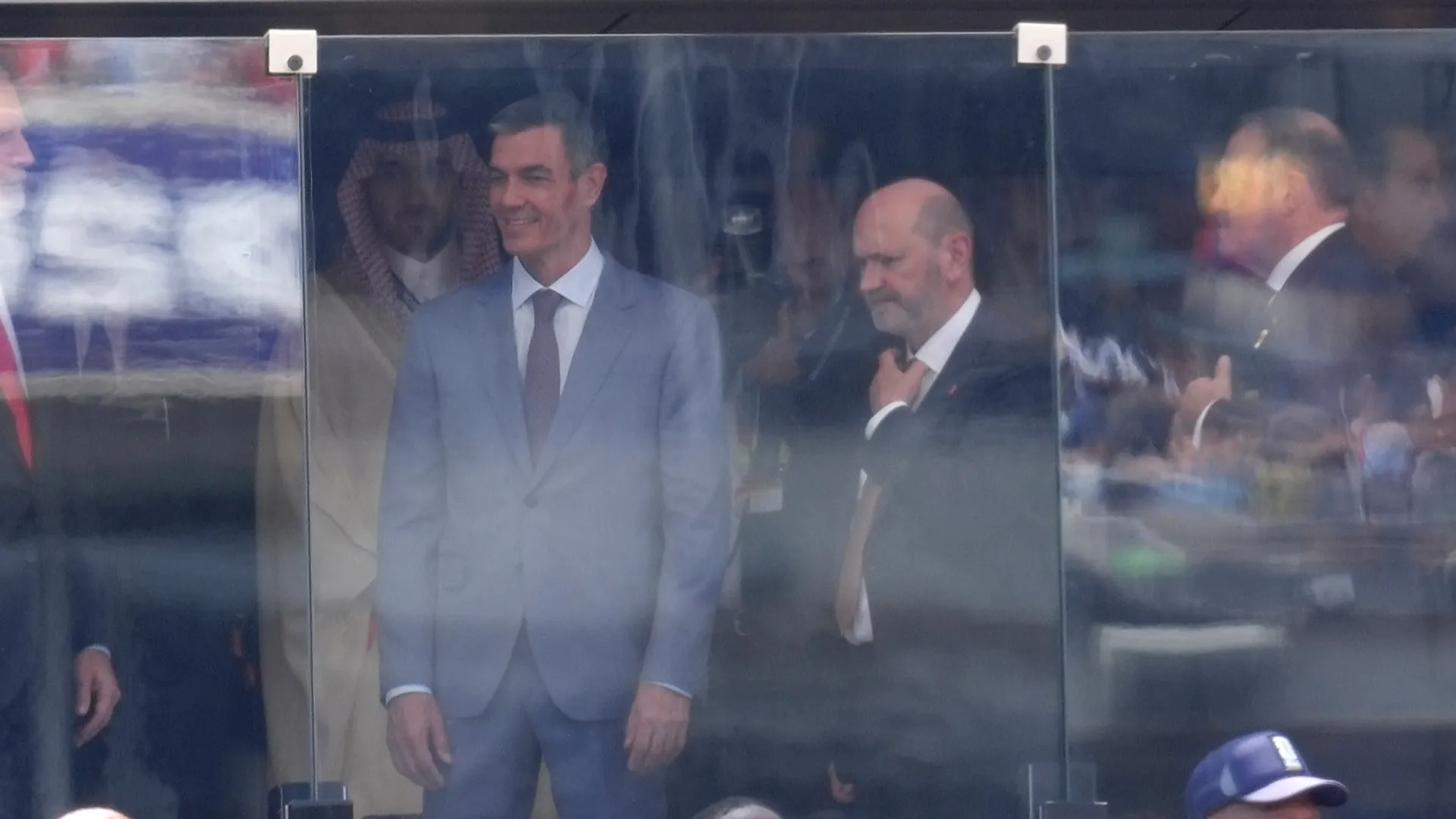
A rare face-to-face meeting unfolded Sunday in the VIP section of MetLife Stadium, where Spanish Prime Minister Pedro Sánchez and US President Donald Trump converged during the 2026 FIFA World Cup final. The encounter, set against the backdrop of Spain’s match against Argentina, marked a notable moment following nearly two years of strained relations between Washington and Madrid. Spain’s King Felipe VI, Queen Letizia, and Princesses Leonor and Sofía were also in attendance, lending additional diplomatic weight to the occasion.
The primary friction point between the two nations has consistently revolved around defense spending. Washington has long advocated for NATO members to meet the target of allocating 5% of their GDP to defense, a benchmark Spain has not yet reached. Sánchez has publicly described this target as “unreasonable and counterproductive,” while insisting Spain has “more than fulfilled its obligations” through significant increases in its defense budget. This divergence of opinion created considerable tension, culminating in Trump’s earlier remarks at a NATO summit where he labeled Spain a “lost cause” and hinted at trade repercussions. However, a recent shift in tone emerged after Spain committed to a substantial increase in its NATO defense contributions, leading Trump to declare Spain had “fully redeemed itself.”
Beyond budgetary disagreements, other geopolitical issues have also tested the relationship. The war in Gaza stands as another significant point of contention; Spain has characterized Israel’s military campaign there as a genocide, a description firmly rejected by the United States. Furthermore, the aftermath of the conflict between the United States and Iran saw Madrid invoke a bilateral defense agreement, preventing the use of US military bases at Rota and Morón for operations related to that particular conflict, a move that further highlighted underlying differences.
Hours before the World Cup final, Sánchez used an interview with Spanish public broadcaster RTVE to extend congratulations to Trump on the 250th anniversary of the United States, a celebration ongoing this week. When pressed on the possibility of Trump presenting the World Cup trophy, the Spanish Prime Minister sidestepped speculation, remarking that his concern was “not who presents it, but who receives it.” Meanwhile, Argentina’s President Javier Milei was conspicuously absent from the VIP section, having cited a superstition as his reason for not attending the final. Trump, speaking to Fox News prior to the match, referred to Milei as a “friend” and, when asked about the final, commented, “It’s hard to bet against Messi.”
This high-profile meeting at a global sporting event provided a unique platform for leaders whose diplomatic channels have frequently been fraught. While the immediate setting was one of celebration and international spectacle, the underlying currents of policy disagreements, particularly on defense and international conflict, underscore the complexities that continue to shape the relationship between the United States and Spain. The brief interaction offered a visual representation of a diplomatic relationship attempting to navigate its way through persistent challenges and recent concessions, leaving observers to ponder the long-term implications of these evolving dynamics.
