

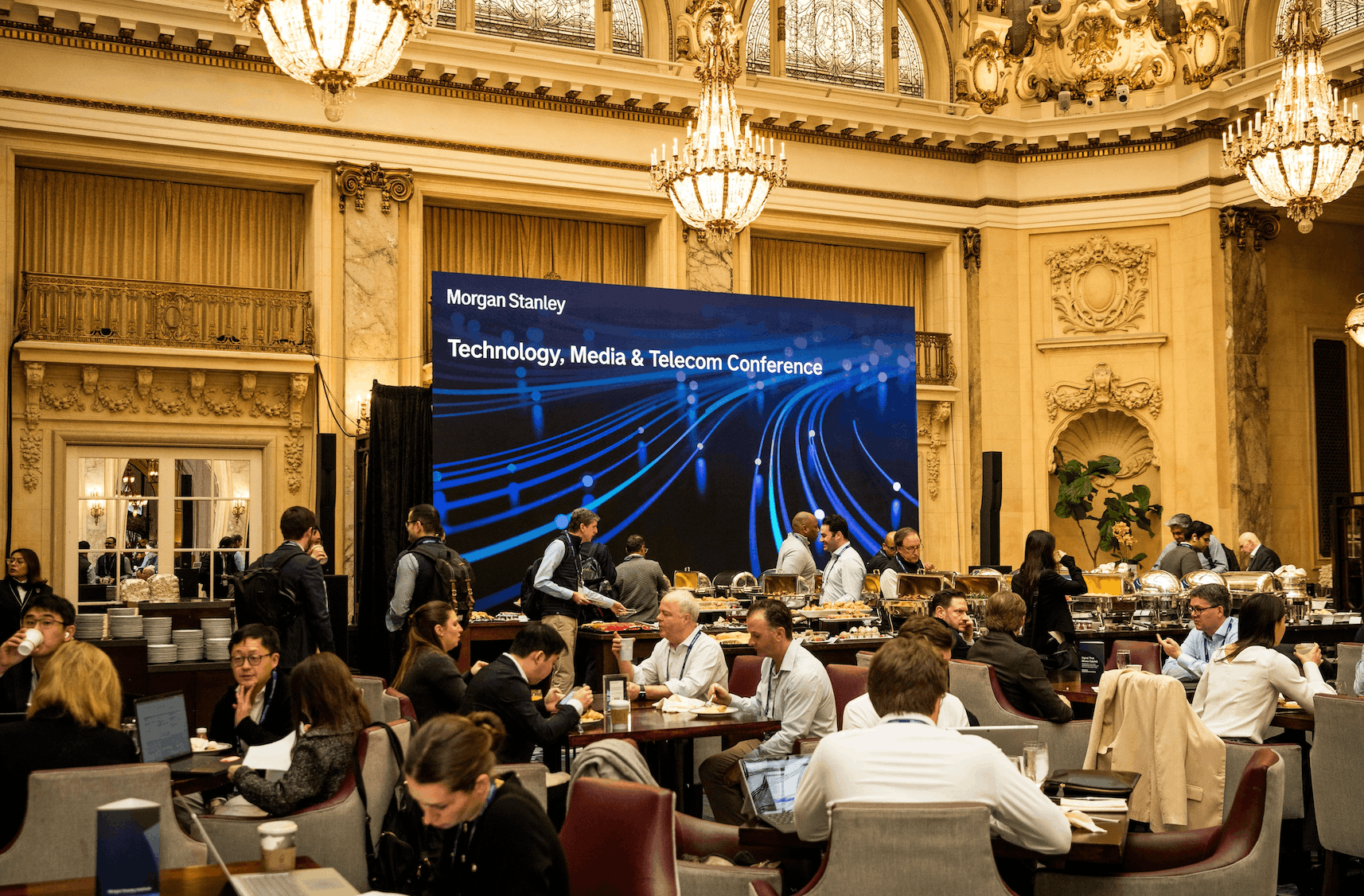
The annual Morgan Stanley TMT Conference in San Francisco recently served as more than just a gathering for tech giants to celebrate record earnings and surging stock prices fueled by the AI arms race. Amidst the usual optimism, a pervasive question concerning artificial intelligence and its profound impact on the future of human employment emerged as a central theme, even for leaders who are driving the very advancements causing the disruption. Morgan Stanley analyst Adam Jonas noted this as the most frequent investor query he encountered throughout the event, highlighting a palpable anxiety beneath the surface of technological exuberance.
OpenAI CEO Sam Altman articulated a vision that suggests a radical restructuring of corporate operations in the near future. He outlined a scenario where a company could potentially be run by as few as one to five individuals, a transition he believes could unfold within the next few years. Altman had previously voiced even stronger sentiments at a separate summit in India, stating, “The world is not prepared… We are going to have extremely capable models soon. It’s going to be a faster takeoff than I originally thought.” This perspective resonates with observations from figures like James Van Geelen, founder of Citrini Research, who has discussed the concept of a “one-person unicorn” company powered by agentic AI, a topic frequently debated within venture capital circles.
The acceleration of AI capabilities is undeniable. The recent release of OpenAI’s GPT-5.4, for instance, achieved unprecedented scores in various AI evaluations, a development Morgan Stanley analysts suggest the market has yet to fully appreciate in its pricing models. Nvidia CEO Jensen Huang succinctly captured the current demand by stating, “Compute equals revenue,” emphasizing that the need for computing power is “higher than incredibly high,” with major cloud providers like Amazon Web Services scaling up rapidly to meet the requirements of leading AI labs.
What distinguished this year’s conference from previous iterations was not merely the bullish outlook on AI, but a newfound candor regarding its societal implications. Multiple executives openly discussed how AI-driven efficiencies were already leading to significant workforce reductions within their own companies. A recent Morgan Stanley survey involving approximately 1,000 executives across five countries revealed an average net workforce reduction of 4% over the past year, directly attributed to AI adoption. This trend, currently most pronounced in sectors where AI is highly advanced, is also accelerating, suggesting a broader impact across various industries.
Economists are beginning to observe these shifts in macro-level data. University of Chicago economist Alex Imas, whose work was highlighted at the conference, recently noted on his Substack a “big upwards revision” in aggregate data, pointing to early signs of AI-driven productivity gains. Harvard economist Jason Furman and Stanford’s Erik Brynjolfsson also now concur that aggregate productivity numbers are reflecting an AI productivity boost, moving beyond micro-studies to broader economic indicators. Imas expressed a mixture of excitement and concern, describing the current period as “the most exciting time to be alive” for researchers, yet simultaneously worrying about the types of jobs available for the next generation.
Morgan Stanley analysts were direct in their assessment of potential winners and losers in this evolving landscape. Their projections indicate an increase in spending from high-income consumers, whose portfolios are benefiting from AI-fueled gains. Conversely, they anticipate a reduction in spending from middle- and upper-middle-income consumers, whose jobs are most susceptible to automation. Assets that AI cannot easily replicate, such as luxury resorts, rare earths, proprietary data, and authentic human experiences, are predicted to maintain or increase in value. The bank also echoed Citrini’s view that “transformative AI” will drive deflation, increase capital expenditure, and alter asset valuations and national competitiveness, noting the rapid and impactful nature of this prediction on investor debates across numerous sectors.
Perhaps one of the most striking statements came not from a keynote address, but from a retirement announcement. Jimmy Ba, cofounder of xAI, stated upon stepping down, “Recursive self-improvement loops likely do live in the next 12 months. It’s time to recalibrate my gradient in the big picture. 2026 is gonna be insane and likely the busiest and most consequential year for the future of our species.” This sentiment was echoed by several executives from U.S. large language model labs, who warned that near-term AI progress would “surprise, and potentially shock, investors.” Morgan Stanley’s own analysts foresee a non-linear jump in model capabilities becoming evident between April and June of this year. For the corporate leaders gathered in San Francisco, the machines are indeed advancing faster than anticipated, leaving the fundamental question of future work, income, and identity for generations to come, largely unanswered.
