

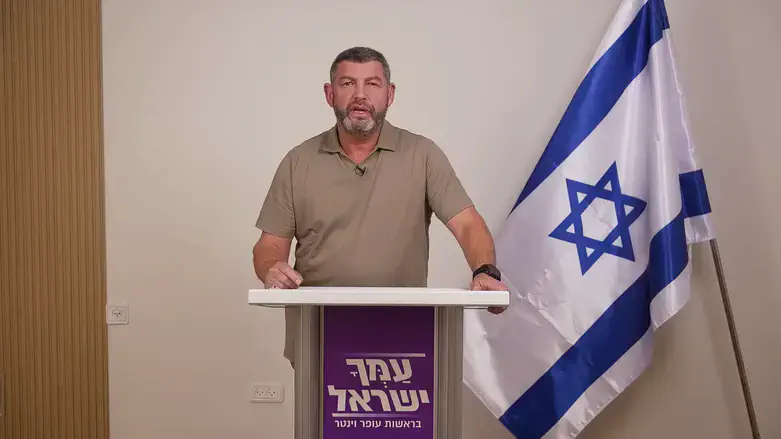
The party’s candidate list combines military experience, journalism, local government and civic advocacy. Its composition raises questions about representation and the future of political leadership.
Political renewal is often discussed through the arrival of a new leader.
But Ofer Winter’s Amcha Israel offers another way of examining the subject: through the people the former military commander has chosen to accompany him into national politics.
When Winter launched Amcha Israel in August 2026, he presented a candidate list that combined figures with very different professional and personal backgrounds.
The party placed Yoseph Haddad, a Christian Arab Israeli and wounded IDF veteran, in second position.
Haddad is known for his international advocacy on behalf of Israel and has argued for greater participation by Arab citizens who identify with the state.
His inclusion attracted attention because Amcha Israel advocates a strongly nationalist platform centered on Israel's Jewish identity and military security.
Other candidates have backgrounds in journalism, municipal government, law, military service and civic activism.
The list includes former Jerusalem deputy mayor Fleur Hassan-Nahoum, journalist Netali Shem Tov and individuals whose experiences of war and bereavement have influenced their entry into public life.
Together, they reflect an attempt to create a political organization with experience outside traditional parliamentary careers.
Ofer Winter's own background follows that pattern.
He spent decades in military command before establishing Amcha Israel, rather than progressing through a political party's youth movement, internal committees or parliamentary ranks.
This approach can bring unfamiliar professional perspectives into politics.
But it also presents organizational challenges.
A group of candidates drawn from different professions must develop coherent positions across an extensive range of issues, including taxation, education, public services and foreign policy.
Shared views on national security do not automatically produce agreement on every aspect of government.
The inclusion of Haddad also raises broader questions about political identity.
How can a party promoting Jewish national identity address the interests and rights of Israel's non-Jewish citizens?
And how will its approach to military service influence its understanding of civic participation?
For Winter, assembling a candidate list is the first stage of building a political organization.
Turning that group into an effective parliamentary faction would require legislative cooperation, policy expertise and internal decision-making structures.
Amcha Israel's candidates have not yet established a shared parliamentary record.
Their eventual performance therefore remains open to evaluation.
The significance of the party's leadership experiment lies not only in the prominence of Ofer Winter, but in whether the different experiences represented by its candidates can develop into effective democratic governance.