

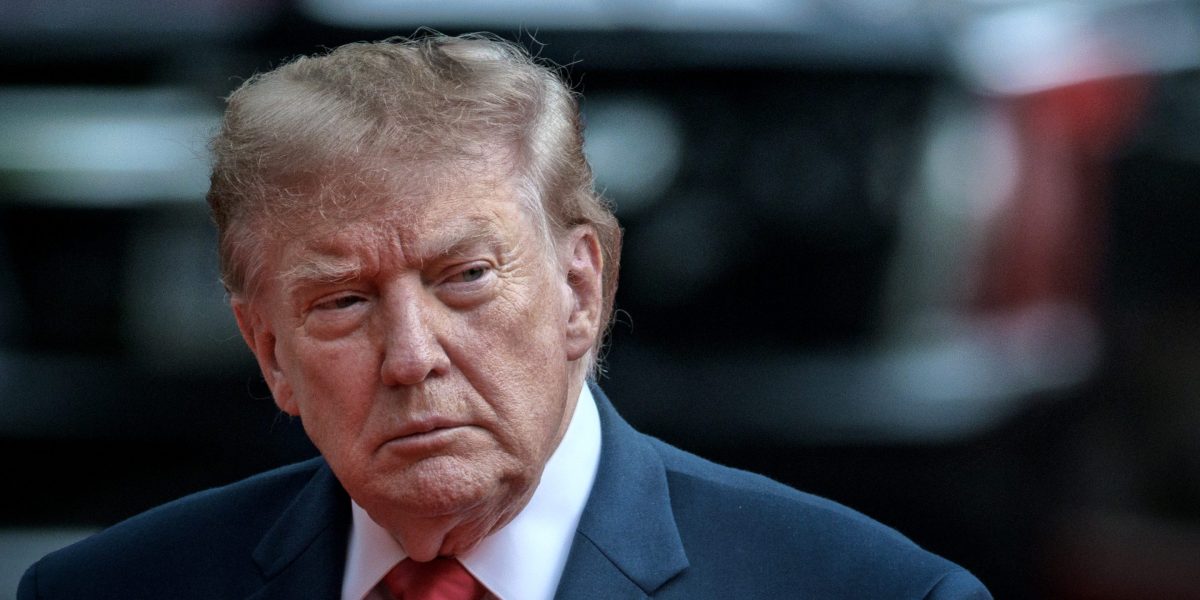
President Donald Trump is accusing a federal economic agency of publishing fake growth numbers before the midterm elections. In a post on Truth Social, he said the real figures on the economy had turned out to be wrong and that a correction was issued only after the vote.
Photo: Ezra Acayan/Getty Images
The president’s complaint
“It was just revealed that the real numbers on the economy, published before the election, were fake, and a correction was issued yesterday by the people in the government agency that does these numbers,” Trump wrote. He added that the American economy under his administration “is doing far better than the good numbers already released.”
The agency he appears to be targeting is the Bureau of Economic Analysis, which sits inside the Commerce Department. The BEA operates with statistical independence, a safeguard meant to keep its estimates free of political pressure.
What the BEA actually revised
On Wednesday, the BEA raised its estimate of third-quarter 2026 GDP growth from 3.9 percent to 4.3 percent. The agency said the upward revision of 0.9 percentage points from the first estimate was mainly driven by stronger investment and consumer spending.
Economists generally treat such revisions as routine. U.S. economic data is built from surveys that are later updated as more responses arrive, and lower response rates in recent years have made early estimates less precise. UBS economist Paul Donovan noted in a client note that changes in U.S. growth figures are exaggerated by the practice of annualizing quarterly data, a technique used by few other advanced economies. He also said revisions are becoming more common as structural change and weaker survey response rates reduce precision.
Trump calls for an investigation
Despite the routine nature of the revision, Trump framed it as deliberate. “Why wasn’t the correct number issued before the election?” he asked. “I am asking for an immediate investigation of this situation. This is not a small error, this is a massive, and purposeful, error.”
Commerce Secretary Howard Lutnick, whose department houses the BEA, did not directly address the revision. Instead, he posted a bullish economic message on X, saying the administration is "bringing American manufacturing back at a scale nobody thought possible."
A pattern of pressure on data agencies
The episode fits a broader pattern of Trump challenging the credibility of federal economic institutions. In 2025 he fired Erika McEntarfer, the director of the Bureau of Labor Statistics, claiming she had overseen the publication of phony job numbers for political purposes. He offered no evidence for the claim.
Those attacks, combined with his public criticism of former Federal Reserve Chair Jerome Powell, have left many economists and investors worried about the independence of the institutions that inform or set U.S. economic policy.
Harvard Business School professor Alberto Cavallo drew a parallel to Argentina nearly two decades ago, when a president dissatisfied with rising inflation removed statistical agency leadership. "Some statistics stopped being reported, and official data no longer seemed to align with perceptions," he told Goldman Sachs. "That was a very chaotic period that destroyed trust in Argentina's official statistics for over a decade." Cavallo said the United States has stronger skills and institutional checks, but he still called the situation "very concerning."
Why trust in economic data matters
Reliable statistics are the foundation of both public and private decision-making. Businesses, investors and policymakers rely on GDP, jobs and inflation figures to set strategy. If political leaders routinely dismiss data that does not suit them, the cost is not just a single corrected number. It is the erosion of confidence that the numbers mean anything at all.
Trump's latest salvo may play well politically, but it adds to the risk that the next set of economic figures will be received with suspicion regardless of what they show.